

 English
 Bahasa Melayu
The Spectrum of Human Action According to the Qur’an
Spectrum +3 Best
Level +3 is the level where an action is carried out at the highest possible quality within a particular situation. It is not merely good. It is not merely better than the ordinary choice. It is the most noble, the cleanest, the closest to taqwā and the furthest from the impulses of the nafs in that situation.
In the Qur’an, this level is often shown through the expression أَحْسَنُ (aḥsanu). This word comes from the root ح س ن, which carries the meanings of good, beautiful, proper, excellent and fine. When it appears in the form أَحْسَنُ, it carries the meaning of better or best, depending on the context.
Therefore, +3 in this spectrum may be understood as the level of aḥsan, meaning the highest quality of action within a particular situation.
The Qur’an states:
ٱدْفَعْ بِٱلَّتِي هِيَ أَحْسَنُ
“…Repel with that which is better…”
Excerpt from Surah Fuṣṣilat 41:34
This verse is extremely important because it is not speaking about goodness in an easy situation. It is speaking about the way to respond to evil. This means a person is facing something painful, challenging or pressuring. In that situation, Allah does not merely command us to respond in the same manner. Allah shows the path of أَحْسَنُ, which is the higher path.
This shows that +3 often appears when we have the opportunity to descend, yet we choose to rise.
- We are able to retaliate, yet we choose a cleaner way.
- We are able to humiliate someone, yet we choose adab.
- We are able to let the ego win, yet we choose truth.
- We are able to act harshly, yet we choose wisdom.
The same verse continues by showing the great effect of this aḥsan choice:
فَإِذَا ٱلَّذِي بَيْنَكَ وَبَيْنَهُۥ عَدَٰوَةٌ كَأَنَّهُۥ وَلِيٌّ حَمِيمٌ...
“…Then suddenly, the one between you and him there was enmity becomes as though he were a close friend.”
Excerpt from Surah Fuṣṣilat 41:34
This shows that a +3 action is not only elevated from the angle of personal character. It also has a social effect. It can extinguish hostility, soften hearts, open the space for peace and transform a harsh situation into something gentler.
However, this level is not easy. That is why the following verse states:
وَمَا يُلَقَّىٰهَآ إِلَّا ٱلَّذِينَ صَبَرُوا۟ وَمَا يُلَقَّىٰهَآ إِلَّا ذُو حَظٍّ عَظِيمٍ
“And it is not granted except to those who are patient, and it is not granted except to one who possesses a great portion.”
Surah Fuṣṣilat 41:35
This verse gives one very important technical foundation. The aḥsan choice is not born from immature emotion. It is born from patience. This means that in order to reach +3, a person must first restrain the lower impulses within himself.
Therefore, +3 has a strong relationship with patience.
- Patience in restraining the tongue.
- Patience in restraining the ego.
- Patience in restraining a hasty reaction.
- Patience in restraining the desire to win.
- Patience in choosing the path that is closer to Allah, not the path that most satisfies the nafs.
The Qur’an also mentions the principle of aḥsan in debate and communication.
...وَجَٰدِلْهُم بِٱلَّتِي هِيَ أَحْسَنُ...
“…And debate with them in the manner that is better…”
Excerpt from Surah an-Naḥl 16:125
This shows that +3 does not only occur in personal character. It also occurs in the way a person argues. Some people argue with evidence, yet their argument is filled with insult. Some people win a debate, yet damage the hearts of others. Some people carry the truth, yet they carry it with ego and condemnation.
The +3 way is to argue with truth without betraying adab. Firm in substance, clean in manner. Sharp in argument, yet not deliberately staining the soul with hatred and humiliation.
The Qur’an also states:
...وَقُل لِّعِبَادِي يَقُولُوا ٱلَّتِي هِيَ أَحْسَنُ
“And say to My servants that they should speak that which is better…”
Excerpt from Surah al-Isrā’ 17:53
This verse shows that the tongue also has levels. Not every true word is necessarily at the best level of quality. There are words that are true but harsh. There are corrections that are true but humiliating. There is advice that is correct but painful because the manner is not guarded.
Therefore, +3 in speech is to choose the expression that brings one closest to truth, causes the least damage to the soul and is furthest from the whispering of Satan.
The continuation of the verse states:
...إِنَّ ٱلشَّيْطَٰنَ يَنزَغُ بَيْنَهُمْ...
“…Indeed, Satan stirs discord between them…”
Excerpt from Surah al-Isrā’ 17:53
This is extremely important. The choice of words can become a gateway for Satan. Therefore, aḥsan words are not merely sweet words. They are words that close the door to corruption, hostility and satanic provocation.
The Qur’an also shows the best level in responding to evil.
...ٱدْفَعْ بِٱلَّتِي هِيَ أَحْسَنُ ٱلسَّيِّئَةَ
“Repel evil with that which is better…”
Excerpt from Surah al-Mu’minūn 23:96
This verse further strengthens the principle that +3 is when evil is faced with a higher choice. Not because we are weak. Not because we are afraid. Rather, because we choose a path higher than merely satisfying anger.
The Qur’an also states:
...وَيَدْرَءُونَ بِٱلْحَسَنَةِ ٱلسَّيِّئَةَ...
“…And they repel evil with good…”
Excerpt from Surah al-Qaṣaṣ 28:54
This verse shows the same principle in another form. Evil does not necessarily have to be answered with evil. There are situations of a higher level where evil is repelled with goodness. This does not mean that every act of oppression must be left alone. It means that in certain situations, the highest choice is to stop the chain of evil with goodness.
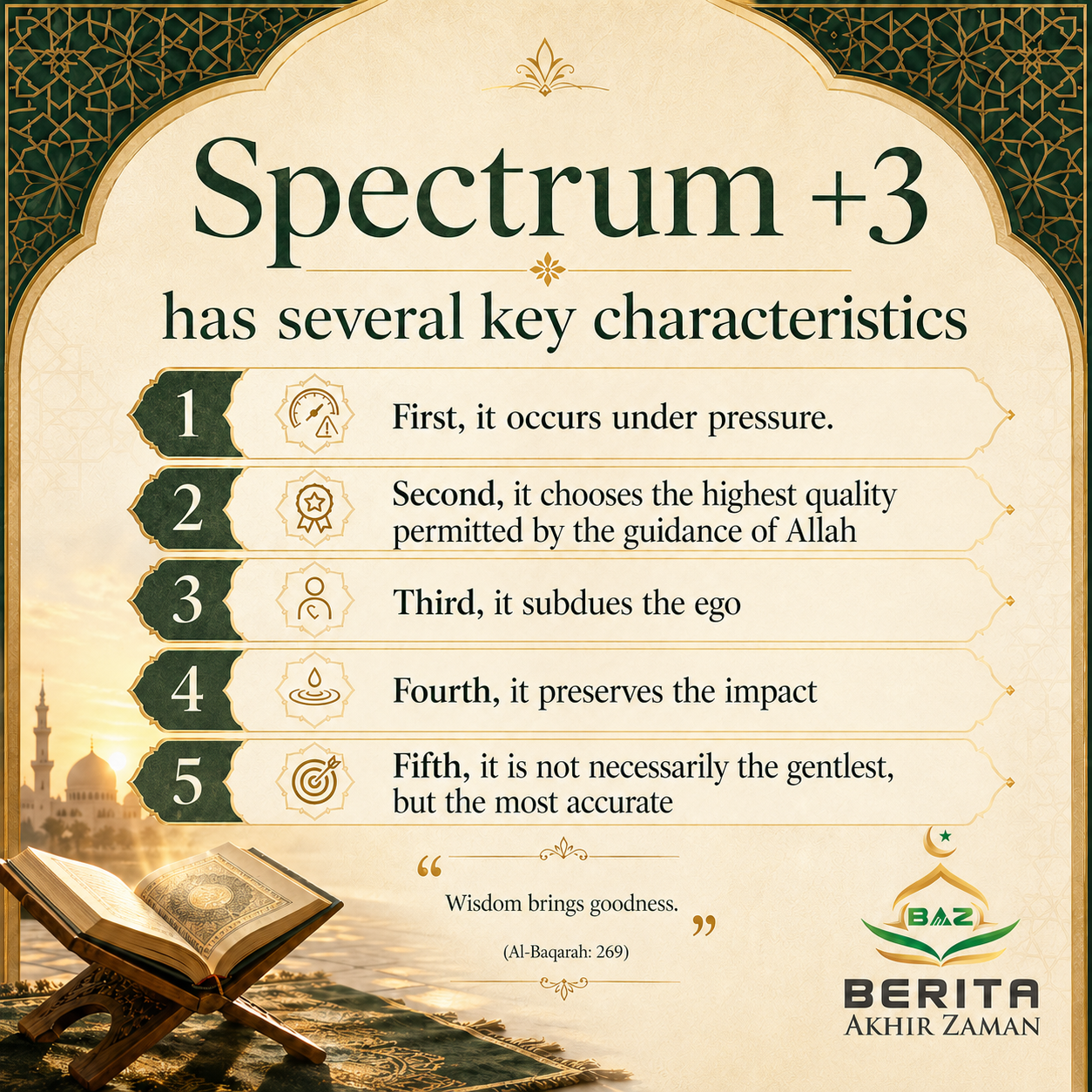
Therefore, technically, Spectrum +3 has several main characteristics.
First, it occurs in a state of pressure. Without pressure, choosing good may be easy. However, +3 usually appears when we are challenged by anger, insult, hostility, oppression, misunderstanding or the desire to retaliate.
Second, it chooses the highest quality permitted by the guidance of Allah. Not every silence is best. Not every gentleness is best. Not every firmness is wrong. Level +3 is choosing the most accurate action in that situation, whether that means remaining silent, answering, correcting, forgiving, separating oneself, rectifying the matter or leaving the affair to Allah.
Third, it subdues the ego. +3 is not merely an action that looks beautiful on the outside. It requires us to examine the inner motive. Are we doing it for Allah, or because we want to be seen as victorious? Are we correcting because we want to improve, or because we want to humiliate? Are we silent because of patience, or because of fear? Are we firm because of truth, or harsh because of ego?
Fourth, it guards the effect. A +3 action does not only look at what we feel. It also looks at the effect of our action upon others, upon truth, upon the atmosphere and upon the path of da‘wah.
Fifth, it is not necessarily the softest action, but the most accurate one. This is important. Aḥsan does not mean always being gentle. There are situations where the best answer is gentleness. There are situations where the best answer is silence. There are situations where the best answer is firmness. There are situations where the best answer is leaving the gathering. There are situations where the best answer is correcting slander clearly. What determines it is the demand of truth, not the appetite of emotion.
Example from the angle of the tongue
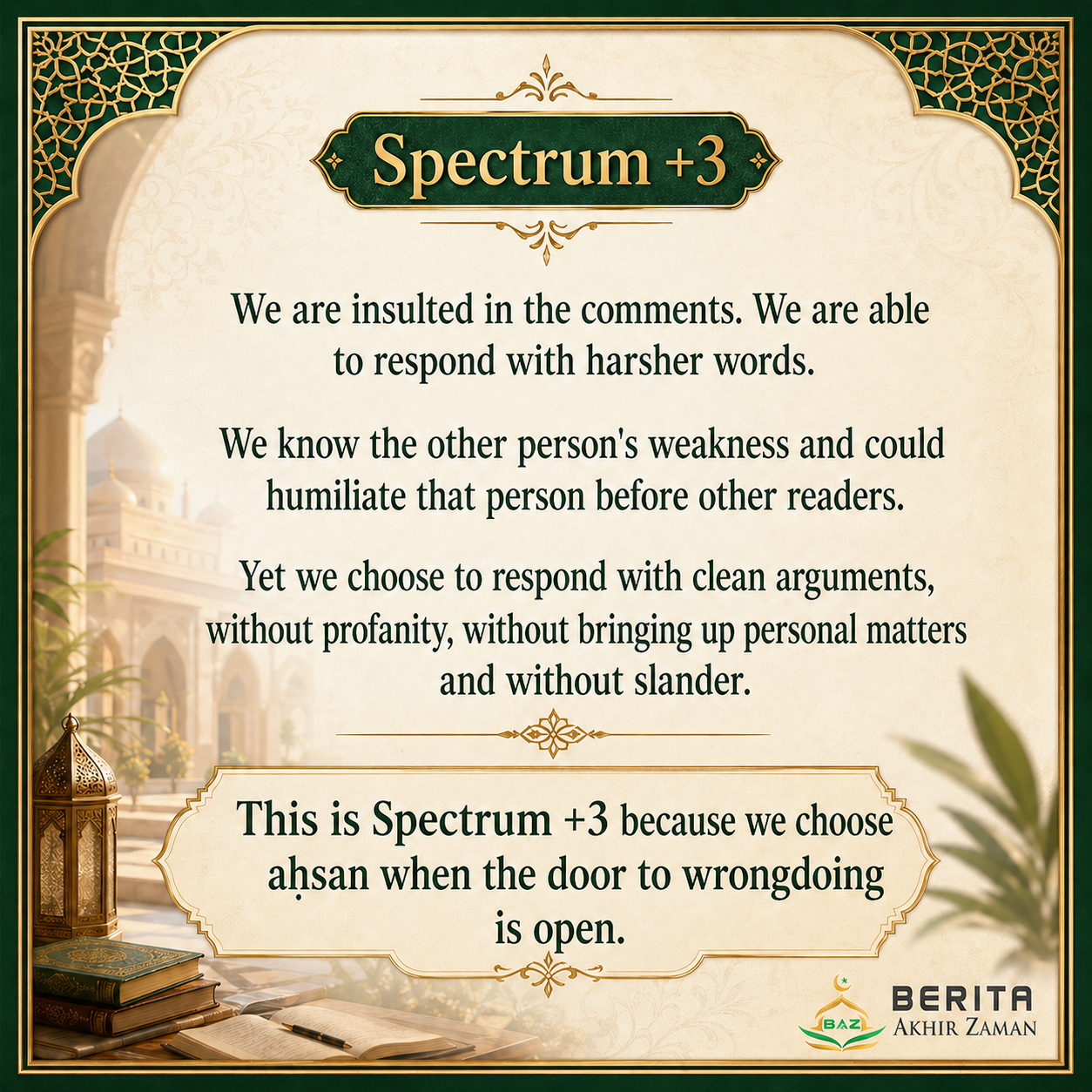
We are insulted in the comments. We are able to respond with sharper words. We know the weakness of the opponent and can humiliate that person in front of other readers. However, we choose to answer with clean argument, without vulgarity, without bringing up personal matters and without slander. This is Spectrum +3 because we choose aḥsan when the door of evil is wide open.
Example from the angle of knowledge
We are writing an article. We find an evidence that could strengthen our view if it were quoted only halfway. However, when read in full, that evidence does not support our argument accurately. The ordinary choice is to keep using that evidence because readers may not notice. The best choice is to be honest, not to manipulate the verse and to correct the framework of the writing. This is Spectrum +3 because we choose the trustworthiness of knowledge over the desire to gain an advantage.
Example from the angle of family
We are angry with a child or spouse. We are able to raise our voice and use our position to force everyone into silence. However, we stop, control our tone, choose words that guide and apologise if we are mistaken. This is Spectrum +3 because we choose responsibility and mercy over the ego of power within the home.
Example from the angle of charity
We give assistance to someone in difficulty. The good choice is to give. The better choice is to give a larger amount according to our ability. The best choice is to give while preserving the dignity of the recipient, not reminding them of the favour, not taking humiliating photos, not turning the assistance into a tool of influence and ensuring that the aid reaches them in the cleanest way. This is Spectrum +3 because the charity is not only given, but its quality is guarded.
Example from the angle of correction
We see the mistake of another person. The bad choice is to insult. The good choice is to correct. The better choice is to correct with evidence. The best choice is to correct with evidence, at the right time, with language that does not destroy dignity and with an intention that truly seeks reform. This is Spectrum +3 because the correction is not only true in content, but also true in manner.
Example from the angle of da‘wah
We face someone who has misunderstood. We could immediately label, attack and humiliate that person. However, we choose to ask first, understand that person’s position, explain in an orderly manner, distinguish between a person who is confused and a person who deliberately deceives and not treat everyone as an enemy. This is Spectrum +3 because we choose wisdom without sacrificing truth.
Example from the angle of silence
We are in a heated discussion. We have an answer, but we know that at that moment, the answer would only add fire, not understanding. So we choose temporary silence, not because we are defeated, but because we are guarding the time, the place and the effect. This is Spectrum +3 if that silence is born from wisdom, not cowardice or laziness in defending the truth.
Example from the angle of correcting a mistake
We have written something and many people have shared it. Later, we realise there is a mistake. The ego-driven choice is to remain silent and hope people do not notice. The good choice is to delete it. The best choice is to correct it clearly, acknowledge the mistake and replace it with more accurate information. This is Spectrum +3 because we choose truth over reputation.
Conclusion
Therefore, Spectrum +3 is the level of aḥsan.
It is not merely good.
It is not merely better.
It is the best choice in a particular situation, especially when there is room for ego, anger, showing off, revenge, manipulation or self-interest to take over.
Spectrum +3 occurs when we choose the highest quality that can be achieved in that situation.
What is best is when truth is guarded, the manner is guarded, the intention is guarded and the effect is also guarded. It is not merely winning in action, but winning over the pull of the nafs when choosing that action.
Reply to: