

 English
 Bahasa Melayu
The Spectrum of Human Action According to the Qur’an
Spectrum -4 Persistently Bad
Level -4 is the level where evil no longer occurs merely once in a while. It has become a habit or a pattern that is maintained, repeated, normalised, defended, protected and continued. At this level, a person does not merely commit a sin. He begins to live with that sin, build excuses for it, defend it, repeat it and even reject the reminders that come to him. Eventually, it is treated as though it has become part of life.
At this level, a person is not merely someone who has committed a sin before. He has begun to become comfortable with it. He searches for reasons to remain there. He rejects correction. He defends the wrongdoing. Sometimes he knows that the action is wrong, but he still chooses to continue it.
This has now entered the most dangerous part. Every human being can make mistakes. Every human being can be weak. Every human being can fall in moments of anger, heedlessness, negligence or a wrong step. However, the real problem begins when a person no longer wants to rise.
He does not want to stop. He does not want to return. He does not want to correct himself. He does not want to admit that the path he is walking is wrong. Even worse, he begins to defend that evil as though it is true.
This is where evil changes from one mistake into a state of life. From one sin into a habit. From one habit into a fortress of ego. From that fortress of ego, the heart becomes increasingly difficult to receive reminders.
Therefore, Spectrum -4 is not merely about a person who falls. It is about a person who chooses to continue living in that fall.
The Qur’an distinguishes between those who make a mistake and then return, and those who persist in wrongdoing.
وَلَمْ يُصِرُّوا عَلَىٰ مَا فَعَلُوا وَهُمْ يَعْلَمُونَ...
“…And they do not persist in what they have done while they know.”
Excerpt from Surah Āli ‘Imrān 3:135
This verse is extremely important as a foundation for -4.
The word يُصِرُّوا carries the meaning of insisting, remaining firmly, being stubborn or continuing in something. Therefore, this verse shows that people of taqwā may make mistakes, but they do not turn the mistake into a place of residence. They do not persist in what they have done while they know.
So the opposite of this state is -4.
That is when a person persists in evil while he knows. He knows his tongue is damaging, but he continues. He knows his writing is misleading, but he defends it. He knows his anger is destroying his family, but he uses the excuse that “this is just how I am”. He knows he is using the verses of Allah to make his own desire win, but he continues because it benefits him. He knows his action is oppressive, but he builds a system or environment so that the oppression appears normal.
The Qur’an also mentions the condition of hearts being covered because of what people have earned.
كَلَّاۖ بَلْ رَانَ عَلَىٰ قُلُوبِهِم مَّا كَانُوا يَكْسِبُونَ
“No indeed. Rather, what they used to earn has covered their hearts.”
Surah al-Muṭaffifīn 83:14
This verse shows the accumulated effect of human actions. Actions that are repeated do not only involve physical implications around a person or outside the body. They can also shape the heart and become layers that block the acceptance of truth.
Repeated evil can become a veil. A sin that is defended can become part of one’s character. Evil that is normalised can become a culture and an attitude. A mistake that is defended can make the heart harder.
Therefore, -4 is the level where evil begins to control the direction of a person’s life.
The Qur’an also mentions the one who takes his desire as his ilah.
...أَفَرَءَيْتَ مَنِ ٱتَّخَذَ إِلَٰهَهُۥ هَوَىٰهُ
“Have you seen the one who takes his desire as his ilah?...”
Excerpt from Surah al-Jāthiyah 45:23
This verse is extremely important for understanding -4 because it shows the condition where a person is no longer merely following desire from time to time. That desire has become the centre of his decisions. What he likes becomes the standard. What benefits him becomes the ruling and the SOP. What satisfies his ego becomes the excuse and the support.
This is the danger of persistent evil. At the beginning, a person only commits a sin. Over time, he defends that sin. Then he builds arguments for that sin. Then he becomes angry at those who correct that sin. Eventually, he turns his desire into the centre of judgement and decision.
The Qur’an also mentions those who continue transgressing in their misguidance.
وَيَمُدُّهُمْ فِي طُغْيَٰنِهِمْ يَعْمَهُونَ...
“…And He leaves them in their transgression, wandering blindly.”
Excerpt from Surah al-Baqarah 2:15
This verse shows a very frightening condition. When a person persists in ṭughyān, meaning transgression beyond limits, he may be left to keep wandering blindly. He thinks he is still walking, while in reality he is being carried away.
Being persistently bad is not only about many sins. It is also about losing sensitivity toward sin. A sin that once made the heart afraid eventually becomes normal.
Oppression that once felt heavy eventually becomes a way of life. Falsehood that once had to be hidden eventually becomes an open strategy.
The Qur’an also mentions people whose evil deeds are beautified for them until they see them as good.
...أَفَمَن زُيِّنَ لَهُۥ سُوٓءُ عَمَلِهِۦ فَرَءَاهُ حَسَنًا
“Then is one whose evil deed has been made attractive to him so he sees it as good?...”
Excerpt from Surah Fāṭir 35:8
This verse is highly precise for -4.
At level -1, a person may know that he is wrong.
At level -2, his evil begins to affect other people.
At level -3, his evil becomes severe because it touches truth, religion or major injustice.
But at level -4, that evil may appear good in his own eyes.
He does not only do what is wrong. He sees that wrong as truth.
He does not only oppress himself. He sees his oppression as struggle.
He does not only deceive. He sees his deception as strategy.
He does not only twist the verses. He sees his distortion as intelligence.
This is among the most dangerous forms in the spectrum.
The Qur’an also mentions those who, when forbidden from causing corruption, claim that they are reformers.
Surah al-Baqarah 2:11-12
وَإِذَا قِيلَ لَهُمْ لَا تُفْسِدُوا۟ فِي ٱلْأَرْضِ قَالُوٓا۟ إِنَّمَا نَحْنُ مُصْلِحُونَ
أَلَآ إِنَّهُمْ هُمُ ٱلْمُفْسِدُونَ وَلَٰكِن لَّا يَشْعُرُونَ“And when it is said to them, ‘Do not cause corruption in the earth,’ they say, ‘We are only reformers.’ Unquestionably, it is they who are the corrupters, but they do not perceive.”
This verse shows a very dangerous form of -4. They are not merely causing corruption. They have already defended that corruption in the name of reform. When they are forbidden from causing fasād, they do not stop. They answer as though they are the ones carrying out iṣlāḥ.
Here, evil has become heavier because the doer no longer sees himself as a corrupter. He sees himself as a reformer. Therefore, the door of repentance becomes more distant because he does not feel that he is doing wrong. He is not only committing fasād. He is building excuses so that fasād appears like goodness.
This is the form of -4 when evil is defended, beautified and given a good name. Fasād is no longer called fasād. It is called reform. Corruption is no longer admitted as corruption. It is defended as struggle, goodness or reform.
The Qur’an also mentions hearts becoming hard.
Surah al-Ḥadīd 57:16
...فَقَسَتْ قُلُوبُهُمْ...
“…So their hearts became hard…”
This verse shows that the heart can change in condition. A heart that repeatedly rejects, delays, defends evil and does not return to reminders can become hard. When the heart becomes hard, advice does not easily enter. The verses of Allah no longer shake awareness. Correction no longer softens the person, and even sin no longer produces fear.
Therefore, -4 is the level where evil does not only occur in action, but begins to shape the heart.
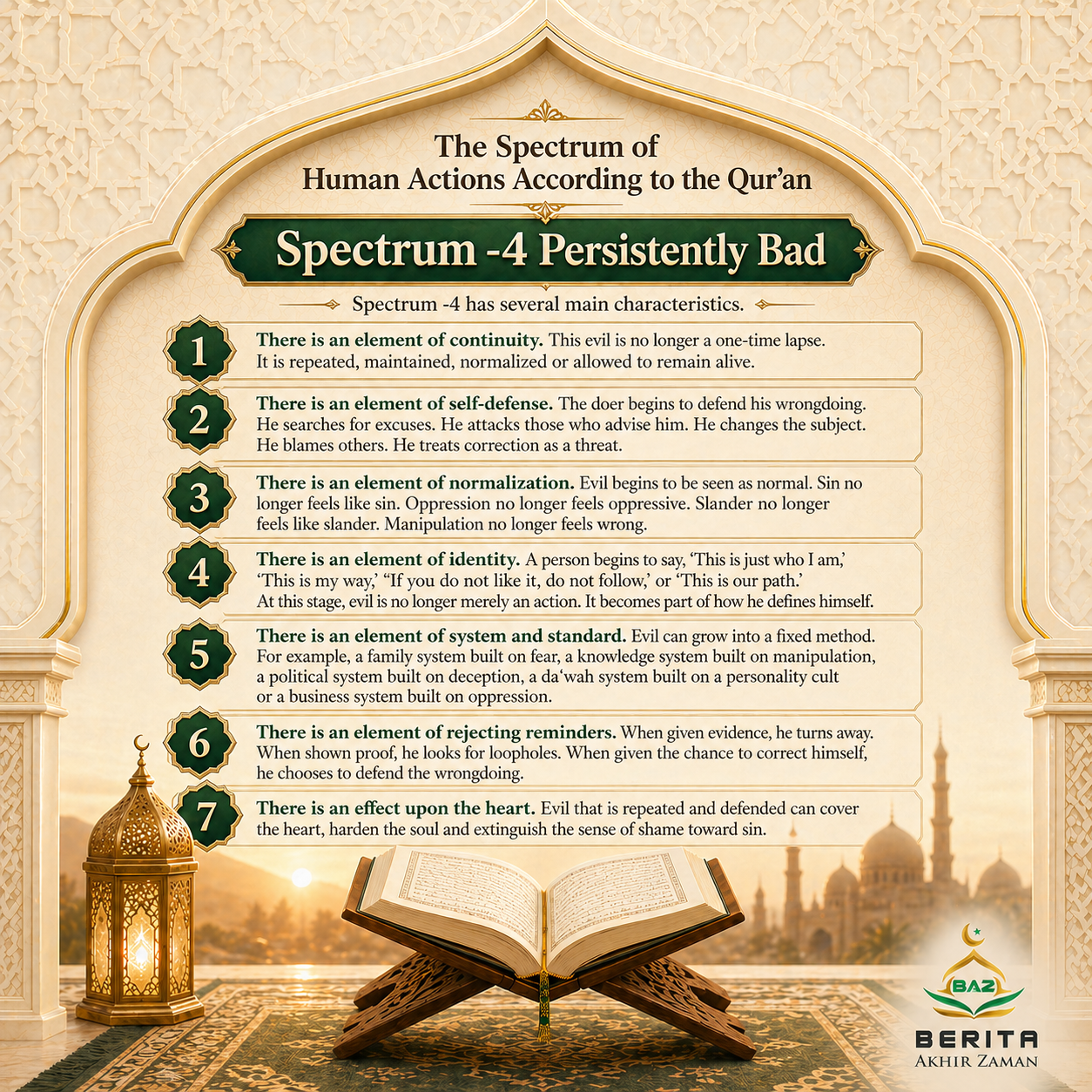
Technically, -4 has several main characteristics.
- First, there is an element of continuity. The evil is no longer a one-time slip. It is repeated, maintained, normalised or allowed to remain alive.
- Second, there is an element of defending it. The doer begins to defend his wrongdoing. He searches for excuses. He attacks those who correct him. He changes the subject. He blames others. He treats correction as a threat.
- Third, there is an element of normalisation. Evil begins to be treated as normal. Sin no longer feels like sin. Oppression no longer feels like oppression. Slander no longer feels like slander. Manipulation no longer feels wrong.
- Fourth, there is an element of identity. A person begins to say, “this is just how I am,” “this is my way,” “if you do not like it, do not follow,” or “this is our path.” At this level, evil is no longer merely an action. It becomes part of how he recognises himself.
- Fifth, there is an element of system and standard. Evil can grow into a fixed method. For example, a family system built upon fear, a knowledge system built upon manipulation, a political system built upon deception, a da‘wah system built upon a personality cult or a business system built upon oppression.
- Sixth, there is an element of rejecting reminders. When given evidence, he turns away. When shown proof, he searches for loopholes. When given the opportunity to correct himself, he chooses to defend the wrongdoing.
- Seventh, there is an effect upon the heart. Evil that is repeated and defended can cover the heart, harden the soul and extinguish the sense of shame toward sin.
Example from the Angle of the Tongue
A person is accustomed to cursing, insulting and belittling others. At the beginning, this may be -1. When he repeats it until people are afraid to approach him, it becomes worse. When he defends it by saying, “I am just the type who speaks directly,” while the reality is that he hurts people, it begins to enter -4. A bad tongue has become an identity.
Example from the Angle of Family
He often scolds his family with harsh words. He knows it wounds them, but he continues to repeat it. When corrected, he says, “If I am not strict, everyone will step on my head.” He turns harshness into a system within the home. The children are afraid, the spouse is pressured and the home loses its peace. This is -4 because evil has become a pattern in life.
Example from the Angle of Knowledge
He already knows that the evidence he uses is not accurate, but he continues using it because that argument is popular and beneficial to him. He does not want to correct old articles. He does not want to admit the mistake. He attacks those who bring the correction. This is -4 because an error in knowledge has been continuously defended.
Example from the Angle of Writing
A person is accustomed to cutting context, selecting half-truths, building misleading titles and directing readers toward false conclusions. At first, it may be one mistake. But when it becomes a fixed writing style, it is -4. Writing is no longer a trust. It has become a machine of manipulation.
Example from the Angle of Religion
A person attributes a false teaching to Allah or the Messenger, then continues to defend it even after evidence of fabrication is presented. He builds followers, attacks critics, changes interpretations, deletes questions and demands obedience to himself. This is -4. Religious falsehood does not merely occur. It becomes a system.
Example from the Angle of Social Media
A person turns slander into fixed content. Every day he searches for issues to burn the emotions of his followers. He knows not all the information is authentic, but he continues because engagement is high. This is -4 because evil has become an industry and a habit.
Example from the Angle of Charity
A person gives assistance, but that assistance is constantly used to buy loyalty, threaten, humiliate recipients and control those in difficulty. If it happens once, it is already bad. If it becomes a fixed method, it is -4. Outward goodness has been turned into a system of control.
Example from the Angle of Power
A person uses his position to cover wrongdoing, pressure subordinates and protect his group. When corrected, he uses the system to punish those who correct him. This is -4 because oppression does not merely happen. It is defended by a structure.
Example from the Angle of Wealth
A person cheats in business dealings. If it happens once and he repents, it may stop as an evil. But if he builds a business model upon deception, conceals defects, oppresses customers and trains workers to lie, that is -4. Sin has become a system of provision.
Example from the Angle of Anger
A person no longer tries to control his anger. He turns anger into a weapon. Everyone must fear him. He uses a raised voice, threats, punitive silence and humiliation as ways to control people. This is -4 because anger has become king within him.
Example from the Angle of Suspicion
A person makes it a habit to think badly of everyone who disagrees with him. He interprets every correction as an attack. He builds a group that lives upon suspicion and hatred. This is -4 because bad suspicion has become a fixed lens through which he sees people.
Example from the Angle of Rejecting Truth
A person is given evidence, given space to check, given clarification and given the chance to return. But he chooses to close his ears, attack the one who brings the evidence and defend the mistake because he fears losing influence. This is -4 because the rejection is no longer ignorance. It has become a stance.
Example from the Angle of Culture
A group normalises insult, slander, manipulation of evidence and personal attacks as a way to defend the group. They train new members to follow that culture. This is -4 on a group scale because evil has been inherited as a shared way of life.
Conclusion
Therefore, -4 is the lowest level of evil in this spectrum.
Not because of one sin alone, but because that sin is not stopped.
Not because of one mistake alone, but because that mistake is defended.
Not because of one injustice alone, but because that injustice is normalised.
Not because of one lie alone, but because that lie is turned into a system.
Not because someone once fell, but because he chooses to remain below while the path of return is still open.
That is why -4 must be viewed with extreme seriousness.
As long as a person realises, stops, repents and corrects himself, he can still rise.
But when a person continues to be stubborn, defends evil, rejects reminders and builds his life upon wrongdoing, he is standing in the most dangerous territory of this spectrum.
Persistently bad is when sin no longer merely occurs, but is repeated, defended, normalised and turned into a habit, identity or system of life. It is the most dangerous condition because evil no longer only corrupts actions, but begins to cover the heart and shape the way a person sees truth.
Reply to: