

 English
 Bahasa Melayu
The Spectrum of Human Action According to the Qur’an
Spectrum -3 Worst
Level -3 is the level where evil reaches a very severe form. It is no longer merely a personal sin. It is no longer merely a mistake that harms other people. It is an evil that touches the foundations of truth, justice, religion, trustworthiness, the verses of Allah, human dignity or major rights.
In simple terms, -3 is when evil has become a major injustice.
- It can occur in several forms.
- Lying in the name of Allah.
- Denying the verses of Allah.
- Fabricating evidence.
- Changing the meaning of religion.
- Declaring lawful what Allah has forbidden.
- Declaring forbidden what Allah has made lawful.
- Using the verses of Allah to make one’s own nafs victorious.
- Deceiving people in the name of religion.
- Concealing the truth after it has become clear.
- Turning power, knowledge or influence into tools of major injustice.
The Qur’an often uses the rhetorical question وَمَنْ أَظْلَمُ, which means “who is more unjust”. This form indicates a very severe level of wrongdoing. It is not a small evil. It stands at an extremely dangerous level.
...وَمَنْ أَظْلَمُ مِمَّنِ ٱفْتَرَىٰ عَلَى ٱللَّهِ كَذِبًا أَوْ كَذَّبَ بِـَٔايَٰتِهِۦ
“And who is more unjust than one who fabricates a lie against Allah or denies His verses?...”
Excerpt from Surah al-An‘ām 6:21
This verse becomes a major foundation for -3. Lying in the name of Allah is not an ordinary sin. It corrupts the source of truth. When someone lies in the name of Allah, he is not merely deceiving people. He is making Allah the support for his lie.
This is extremely serious because people may accept something not because its argument is true, but because it is attached to the name of Allah.
The Qur’an also states:
فَمَنْ أَظْلَمُ مِمَّن كَذَبَ عَلَى ٱللَّهِ وَكَذَّبَ بِٱلصِّدْقِ إِذْ جَآءَهُ...ۥٓ
“Then who is more unjust than one who lies against Allah and denies the truth when it comes to him?...”
Excerpt from Surah az-Zumar 39:32
This verse combines two grave evils.
- First, lying in the name of Allah.
- Second, denying the truth after the truth has come.
This is no longer merely a person not knowing. This is a state where the truth has already come, yet he chooses to reject it, cover it or fight against it. Therefore, -3 is not only measured by the outward act, but also by one’s attitude toward the truth once it has become clear.
The Qur’an also states:
...وَمَنْ أَظْلَمُ مِمَّن ذُكِّرَ بِـَٔايَٰتِ رَبِّهِۦ فَأَعْرَضَ عَنْهَا وَنَسِيَ مَا قَدَّمَتْ يَدَاهُ
“And who is more unjust than one who is reminded of the verses of his Rabb, then turns away from them and forgets what his own hands have put forward?...”
Surah al-Kahf 18:57
This verse shows that turning away from the verses of Allah after being reminded is also a major injustice. It is not merely ignorance. It is not merely a case where information has not reached someone. It is a state where the verses have been brought, the reminder has reached him, yet the person chooses to turn away.
- This can happen to a reader.
- This can happen to a writer.
- This can happen to a preacher.
- This can happen to a religious figure.
- This can happen to a leader.
- This can happen to anyone.
When the verses of Allah are no longer treated as the foundation and measure, human beings will begin to turn the nafs, madhhab, group, interest, influence or ego into their scale.
The Qur’an also speaks about people who conceal clear proofs and guidance.
إِنَّ ٱلَّذِينَ يَكْتُمُونَ مَآ أَنزَلْنَا مِنَ ٱلْبَيِّنَٰتِ وَٱلْهُدَىٰ مِنۢ بَعْدِ مَا بَيَّنَّٰهُ لِلنَّاسِ فِي ٱلْكِتَٰبِ
“Indeed, those who conceal what We have sent down of clear proofs and guidance after We have made it clear to people in the Book...”
Excerpt from Surah al-Baqarah 2:159
This verse is important because -3 does not only occur through active fabrication. It can also occur through concealing the truth. When someone knows a clear proof from Allah but conceals it for personal interest, group interest, power, money or position, that evil becomes severe.
- Concealing the truth can mislead people.
- Concealing evidence can obstruct people from guidance.
- Concealing information that must be clarified can cause people to remain trapped in misunderstanding.
The Qur’an also speaks about mixing truth with falsehood.
وَلَا تَلْبِسُوا۟ ٱلْحَقَّ بِٱلْبَٰطِلِ وَتَكْتُمُوا۟ ٱلْحَقَّ وَأَنتُمْ تَعْلَمُونَ
“And do not mix truth with falsehood and conceal the truth while you know.”
Surah al-Baqarah 2:42
This verse gives a very strong technical foundation for -3. There are two forms of severe evil here.
- First, mixing truth with falsehood.
- Second, concealing truth while knowing.
This is more dangerous than clear falsehood. When falsehood comes as falsehood, people may recognise it more easily. But when falsehood is mixed with some truth, people are easily deceived.
This is the form of -3 in writing, da‘wah, politics, ideology, religious debate and the manipulation of evidence.
The Qur’an also warns against falsely declaring something lawful or forbidden.
...وَلَا تَقُولُوا۟ لِمَا تَصِفُ أَلْسِنَتُكُمُ ٱلْكَذِبَ هَٰذَا حَلَٰلٌ وَهَٰذَا حَرَامٌ لِّتَفْتَرُوا۟ عَلَى ٱللَّهِ ٱلْكَذِبَ
“And do not say, concerning the lie your tongues describe, ‘This is lawful and this is forbidden,’ in order to fabricate a lie against Allah...”
Excerpt from Surah an-Naḥl 16:116
This verse is extremely important. Declaring lawful and forbidden without right is a severe evil. It is not merely a wrong opinion. It can become a lie against Allah when someone attributes a ruling to Allah without knowledge.
This enters -3 when a person boldly invents rulings, fabricates support, twists the meanings of verses or uses religion to control people according to his own desire.
The Qur’an also states:
وَأَن تَقُولُوا۟ عَلَى ٱللَّهِ مَا لَا تَعْلَمُونَ...
“...And that you say about Allah what you do not know.”
Excerpt from Surah al-A‘rāf 7:33
This verse shows that speaking in the name of Allah without knowledge is a grave matter. It is placed within a list of major prohibitions. Therefore, anyone who writes, teaches, argues, gives fatwa, makes religious claims or attributes something to Allah must be extremely careful.
Not every mistake immediately becomes -3.
A person may make a mistake due to ignorance, limited knowledge or misunderstanding. However, when someone speaks in the name of Allah without knowledge, with certainty, while misleading people and refusing to correct himself after the matter becomes clear, that evil can rise to a very severe level.
However, this verse is not only a warning to writers, teachers or those who first make religious claims. It is also a warning to readers, commenters and objectors.
There are situations where a writer is wrong because he speaks in the name of Allah without knowledge. That is indeed serious. However, there are also situations where a writer has brought verses, arranged arguments, explained the meaning of the wording and built his conclusion with trustworthiness, but the reader rejects without knowledge, objects without evidence, accuses without proof or mocks the verse being presented.
In such a situation, the reader is no longer merely “disagreeing”. He himself may enter the territory of speaking about Allah without knowledge.
Not everyone who has not yet accepted an argument is immediately guilty. Some people do not understand yet, so they ask. Some are confused, so they seek clarification. Some read sincerely, but are not yet convinced. All of this still belongs to the space of seeking knowledge.
The problem begins when a person fights an argument with ego, rejects evidence without checking, twists the meaning of a verse, accuses the writer of bringing misguidance without proof or prevents others from reading a true explanation. At that point, he is not merely failing to accept knowledge. He is beginning to turn his comment into an obstacle for others.
Therefore, in this matter, the danger does not exist only in the writer who writes about religion without trustworthiness. The danger also exists in the reader who rejects truth without knowledge.
A writer must fear writing in the name of Allah without knowledge. A reader must also fear rejecting something true without knowledge. A commenter must fear turning a comment into a doorway of fitnah. An objector must fear when his objection is not born from evidence, but from ego, anger, suspicion or an old familiar belief that he is holding on to.
For this reason, a person who reads religious writing must distinguish between “I do not understand yet” and “this is wrong”. Not understanding yet is not an argument for rejection. Not having heard something before is not proof that it is false. Being unfamiliar with a conclusion is not a reason to accuse someone else of misguidance.
If a writer is wrong due to ignorance and then corrects himself once it becomes clear, that mistake does not necessarily move to a more severe level. However, if a reader rejects the truth after it has become clear, spreads objections without knowledge and prevents others from examining the evidence, that evil can move from a personal wrong to a wider effect. It can enter the territory of -2. If he attributes his false objection to Allah with certainty, it can approach the territory of -3.
Therefore, in religious knowledge, the one being tested is not only the person who writes.
- The one who reads is also tested.
- The one who comments is also tested.
- The one who shares is also tested.
- The one who objects is also tested.
The final question is not merely who writes and who reads. The final question is whether we are submitting to the guidance of Allah, or defending ourselves in the name of religion.
The Qur’an also mentions those who write scripture with their own hands and then attribute it to Allah.
...فَوَيْلٌ لِّلَّذِينَ يَكْتُبُونَ ٱلْكِتَٰبَ بِأَيْدِيهِمْ ثُمَّ يَقُولُونَ هَٰذَا مِنْ عِندِ ٱللَّهِ
“So woe to those who write the Book with their own hands, then say, ‘This is from Allah’...”
Excerpt from Surah al-Baqarah 2:79
This verse is very clear as a foundation for -3 in religious fabrication. To write something from oneself, then claim that it is from Allah, is an extremely severe evil. It corrupts the source of religion, deceives people and sells falsehood in the name of revelation.
In the modern context, its forms can usually appear as:
- Fabricating evidence,
- Inventing narrations,
- Changing translations,
- Cutting the context of a verse,
- Creating a new teaching and then attributing it to Allah, or
- Treating human writing as though it came from revelation.
The Qur’an also speaks about selling the verses of Allah for a small price.
...وَلَا تَشْتَرُوا۟ بِـَٔايَٰتِي ثَمَنًا قَلِيلًا...
“...And do not exchange My verses for a small price...”
Excerpt from Surah al-Baqarah 2:41
This verse shows that exploiting the verses of Allah for worldly interest is a major evil. A small price is not only money. It can be position, influence, reputation, human support, victory in debate, power, political gain or acceptance by a group.
When the verses of Allah are no longer read in order to submit to Allah, but are used to purchase worldly interests, that action stands in a dangerous territory.
The Qur’an also warns those who take religion as play and amusement.
...ٱلَّذِينَ ٱتَّخَذُوا۟ دِينَهُمْ لَهْوًا وَلَعِبًا وَغَرَّتْهُمُ ٱلْحَيَوٰةُ ٱلدُّنْيَا
“Those who took their religion as amusement and play, and the life of this world deceived them...”
Excerpt from Surah al-A‘rāf 7:51
This verse shows that making a game of religion also belongs to the territory of severe evil. Religion is not material for manipulation. Religion is not a tool of ego. Religion is not theatre. Religion is not capital for influence. When people make a game of religion, the effect is not only upon themselves, but also upon the way others see truth.
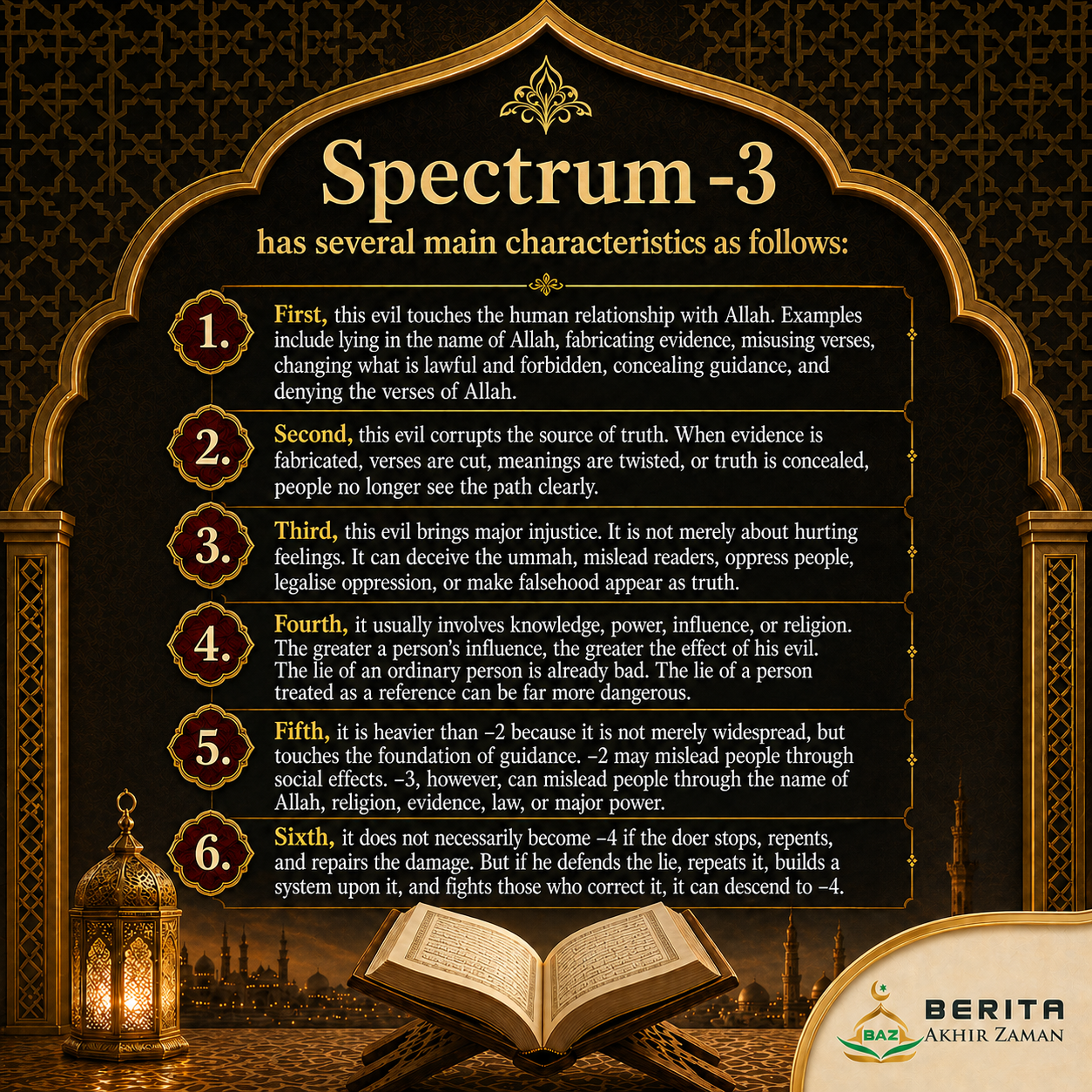
Technically, -3 has several main characteristics as follows.
- First, the evil touches the human relationship with Allah. Examples include lying in the name of Allah, fabricating evidence, misusing verses, changing what is lawful and forbidden, concealing guidance and denying the verses of Allah.
- Second, the evil corrupts the source of truth. When evidence is fabricated, verses are cut, meanings are twisted or truth is concealed, people can no longer see the path clearly.
- Third, the evil brings major injustice. It is not merely hurting feelings. It can deceive the ummah, mislead readers, oppress human beings, make oppression appear lawful or make falsehood appear as truth.
- Fourth, it usually involves knowledge, power, influence or religion. The greater a person’s influence, the greater the effect of his evil. The lie of an ordinary person is already bad. The lie of someone treated as a reference can be far more dangerous.
- Fifth, it is heavier than -2 because it does not merely spread widely, but touches the foundation of guidance. -2 may mislead people through social effects. -3, however, can mislead people through the name of Allah, religion, evidence, law or major power.
- Sixth, it does not necessarily become -4 if the doer stops, repents and repairs the damage. But if he defends the lie, repeats it, builds a system upon it and fights those who correct it, it can descend to -4.
Example from the Angle of Religion
A person invents a religious claim without evidence and attributes it to Allah. He says something is lawful or forbidden without knowledge. This is -3 when the claim deceives people and changes their relationship with the law of Allah.
Example from the Angle of Interpreting Verses
A person cuts a verse or chooses a translation that benefits his view, while the context of the verse does not support it. If he does this deliberately to make his own desire victorious, this is -3. The verse of Allah is turned into a tool of ego, not a helper of truth.
Example from the Angle of Hadith or Narration
A person spreads a fabricated narration and then makes it the basis of creed, law or allegiance to a particular figure. This is -3 because it falsifies religion and drags people toward a false support.
Example from the Angle of Writing
A person writes a religious article while deliberately twisting evidence, concealing the part that weakens his argument and building a conclusion that he knows is not true. This is not merely a writing mistake. This is -3 because the writing becomes a tool to deceive readers in the name of truth.
Example from the Angle of Da‘wah
A person uses the verses of Allah to threaten people so that they submit to him, not to Allah. He turns religion into a tool for controlling followers, collecting funds, shutting down questions and preventing people from checking. This is -3 because the verses of Allah are exploited for personal power.
Example from the Angle of Family
A head of family uses religion to oppress his family. He quotes evidence about obedience, but conceals evidence about trustworthiness, mercy, justice and the prohibition of oppression. If religion is used to cover oppression, that can become -3 because the evidence of Allah is used as a shield for the demands of the nafs.
Example from the Angle of Power
A leader uses religious justification to legalise oppression, cover corruption or deceive the people. This is -3 because religion is turned into a mask for major injustice.
Example from the Angle of Knowledge
A knowledgeable person or someone with an influential position knows an important piece of information that could correct public misunderstanding, but conceals it out of fear of losing influence or followers. This is -3 when that concealment causes people to remain far from the truth.
Example from the Angle of Social Media
A person uses video clips, pieces of verses or incomplete quotations to create religious slander. He knows the original context is different, but still spreads it because he wants to win the narrative. This is -3 because he is no longer merely sharing wrong information. He is deliberately constructing falsehood.
Example from the Angle of Charity and Assistance
A person uses religious assistance to enslave the recipient. He says the assistance is “for the sake of Allah”, but in reality it is a tool to buy loyalty, silence people and force support. This can become -3 if the name of religion is used to control people unjustly.
Example from the Angle of Debate
A person loses the argument, then fabricates sources, changes the meaning of terms, attributes his own opinion to Allah and accuses the one who brings the verse of being an enemy of religion. This is -3 because he is no longer merely arguing wrongly. He is corrupting the scale of truth.
Example from the Angle of Education
A teacher or speaker teaches something he knows is not true, but continues because it has already become a sales product, a printed book, a teaching module, an influence or the identity of his group. This is -3 because knowledge has been turned into a trade of falsehood.
Example from the Angle of Halal and Haram Rulings
A person declares lawful what Allah has forbidden or declares forbidden what Allah has made lawful for the interest of a group, business, politics or influence. This is -3 because he enters the territory of speaking in the name of Allah without right.
Conclusion
Therefore, -3 is a very severe level of evil.
It is not only because the action itself is evil.
It is the worst because it corrupts the scale by which human beings recognise truth.
When people are deceived about Allah, deceived about the verses of Allah, deceived about the law of Allah or deceived about the path toward Allah, the damage is far greater than personal evil.
That is why -3 must be stated firmly.
Lying in the name of Allah is not an ordinary evil.
Twisting the verses of Allah is not an ordinary evil.
Fabricating religion is not an ordinary evil.
Concealing guidance is not an ordinary evil.
Using religion to oppress people is not an ordinary evil.
The worst is when evil touches the source of truth, corrupts the human relationship with Allah, fabricates guidance, conceals verses or uses religion and power to deceive and oppress human beings.
Reply to: